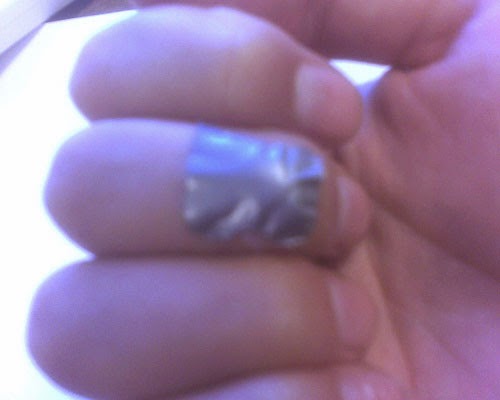
In patients treated with duct tape, 85 percent of the warts completely
resolved, compared with 60 percent in the cryotherapy group. These
results were statistically significant. Resolution of warts treated with
duct tape usually occurred within the first 28 days of therapy. If
there was no response within the first two weeks, the warts were
unlikely to respond to a longer course of therapy. The main adverse
outcomes with duct-tape therapy were difficulty keeping the tape on the
wart and minor skin irritation. The main adverse effect in the
cryotherapy group was mild to severe pain at the freeze site during and
after the treatment.
A recent study showed that duct tape wiped out more warts than conventional freezing did. In this study, warts were covered with duct tape for six days. Then, the warts were soaked in warm water and rubbed with an abrasive such as pumice stone. The treatment was repeated for as long as two months.
However, subsequent research has not found duct tape to be significantly effective for treating warts.
You can treat warts at home with medications from the drugstore. Get a patch or solution that contains 17 percent salicylic acid. You have to use these products daily for weeks.
Two of these medications are Compound W and Occlusal-HP. Dr. Scholl makes a different product called Freeze Away that it claims that it removes warts "with as few as one treatment."
Warts are benign skin growths caused by human papillomavirus (HPV). Like other infectious diseases, wart viruses pass from person to person. You can also get the wart virus by touching an object used by someone who has the virus.
Warts are usually rough and skin-colored. However, they can be dark, flat and smooth.
Warts may grow one at a time or in bunches. They may bleed if picked or cut. They often contain one or more tiny black dots, which are sometimes called wart seeds. These dots are small, clotted blood vessels.
There are several kinds of warts.
Common warts grow on hands. They are more common where skin has been broken, such as where fingernails are bitten.
Plantar warts are found on the soles, or plantar area, of feet. Walking pushes plantar warts back into the skin. They can be painful. When they grow in clusters, they are known as mosaic warts.
Flat warts are small, smooth and tend to grow in large numbers. They can show up anywhere on the body. They are often found where people shave—the face on men and the legs on women. Irritation from shaving probably contributes to the development of flat warts.
Genital warts are sexually transmitted. They can appear externally or internally.
The wart virus affects people differently. Some people get warts; others don't. The likelihood of getting warts is similar to the chances of catching a cold. If your immune system is weak, you will be more prone to getting warts.
Freezing — or cryotherapy — is one method for removing warts. Burning — or electrosurgery — is an alternative. Lasers are used when other therapies fail. There are also surface-peeling preparations such as salicylic acid. Retinoids, which are medications derived from vitamin A, are used to disrupt a wart's skin cell growth.
Another treatment is to inject each wart with an anti-cancer drug called bleomycin. The injections may be painful and can have other side effects. Immunotherapy, which attempts to use the body's own rejection system is an additional treatment method.
New warts should be treated as soon as possible to prevent them from shedding virus into nearby skin and creating additional warts.
Are warts contagious?
Warts come from the human papilloma virus, or from one of its 48 different subtypes, and enter the skin by direct contact. They thrive in moist environments but can occur anywhere.
Once on the skin these viruses develop into nodules, usually gray-colored, benign protuberances that are highly contagious and easily spread by skin contact. Some warts will disappear over time if the immune system recognizes it as a virus and produces an antibody, but this is very rare. Warts are most effectively treated and removed by dermatologists.
Warts are found in multiples, do not bleed or itch, and with the exception of the plantar wart on the foot, do not cause pain. They are most commonly found on the fingers, hands, and soles of the feet. On the hands they are pale with a roughened appearance. Skin lines tend to go around them rather than through them. On the neck and face, warts tend to be small and smooth, while the painful plantar wart found on the ball or heel of the foot has the roughened look of a callus.
Children and teenagers are usually affected by warts because their still-developing immune system does not recognize or fight the wart virus. This changes as they age. The best precaution against plantar warts is not to go barefoot in locker rooms, poolside, or in hotels. The seemingly skimpy protection offered by wearing flip-flops or other sandals is actually all that's needed because it keeps the skin away from the wart virus.
Labels:
are warts contagious
How to get rid of plantar warts?
These are the following effective methods how to get rid of warts:
1.) Try salicylic acid and duct tape. Salicylic acid is the active ingredient in most over-the-counter wart remedies such as Compound W, Ocusal, and WartStick.
2.) Try cryotherapy. While not as powerful as a doctor's liquid nitrogen treatment, cryotherapy products such as Compound W Freeze Off or Dr. Scholl's Freeze Away Wart Remover can be purchased over the counter, without a prescription. Still, they've been know to be effective, if somewhat more painful than a doctor's methods.
3.) Use apple cider vinegar. This has had some success, as the mild acid helps dissolve the wart.
4.) Use podophyllum. This ointment is a plant extract that goes by many names, including American mandrake, Himalayan mayapple, and Devil's apple. It may work by killing the infected skin cells, but it's toxic, so to be avoided by pregnant or nursing mothers.
5.) Use cantharidin. This is similar to the salicylic method above, only with the addition of cantharidin, which is a substance extracted from a blister beetle. A mixture of salicylic acid and cantharidin is applied to the wart, and covered with a bandage. In about a week, the doctor will remove the dead part of the wart. This method also involves a bit of pain from the blister.
6.) Try immunotherapy. For really stubborn warts, your physician may try immunotherapy, or getting your body's immune defenses assigned to attacking your wart. Injecting interferon into the wart triggers an immune system response that will "reject" the wart. You may experience flu-like systems for a few hours after treatment. Injecting an antigen (commonly, mumps antigens) will similarly trigger an immune response that will kill the wart.
7.) Use imiquimod. This is a prescription cream that triggers your body to release proteins (cytokines) that will attack HPV. Imiquimod can cause severe inflammation and tissue damage near the wart, and should be discontinued if that occurs.
8.) Try laser treatments. These precisely-targeted lasers will cauterize the capillaries carrying blood to the wart, starving it and causing it to die. It can be painful and even scarring, but has a good chance of destroying the wart.
How do you get warts?
Viruses called human papillomavirus (HPV) cause warts. It is easier to catch a virus that causes warts when you have a cut or scrape on your skin. This explains why so many children get warts. Warts also are more common on parts of the body that people shave such as the beard area in men and the legs in women. You can spread warts from one place on your body to another.
A wart is typically a small growth that appears on a person's hands or feet and looks like a solid blister or a small cauliflower. They may also appear in other parts of the body.
Warts have a rough texture and are caused by viruses, particularly one of several kinds of HPV (human papillomavirus).
The virus causes keratin, which is a hard protein on the top layer of the skin, to grow too fast.
Warts are not the same as moles. Moles are dark and may become quite large, while warts are nearly always small and have the same color as the person's skin.
Labels:
how do you get warts
Subscribe to:
Posts (Atom)


